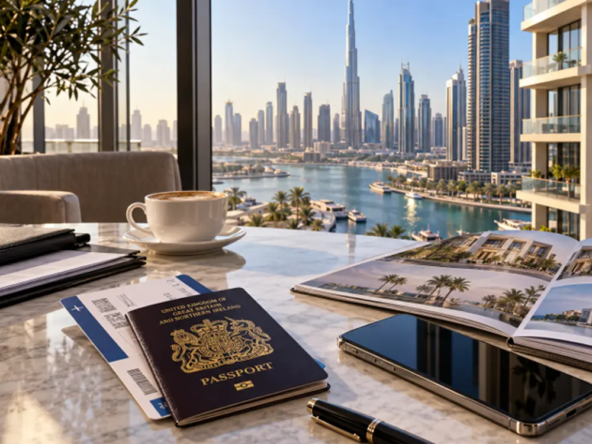
The question “Is now the right time to buy property in Dubai?” is resonating with both local and international buyers in 2025. The city of Dubai has once again captured global attention in its real estate market — buoyed by strong demand, rising prices, and new supply. But as always, timing, strategy and understanding the underlying fundamentals matter. In this blog post we’ll explore the key factors shaping Dubai’s property market, what the data tells us, what risks watching, and how an investor should think about progressing now.
1. Market momentum – strong transaction volumes and price growth
There is clear evidence that the Dubai property market is in an active phase. For example:
- In the first nine months of 2025, Dubai recorded 158,200 transactions valued at around AED 498.8 billion — representing about a 20.5 % year-on-year increase in volume and 32.3 % in value compared with the same period in 2024.
- Property prices continue their upward trajectory: according to valuation firm ValuStrat, apartment prices rose about 20 % year-on-year in early 2025 and villas even more strongly.
- Rental growth remains positive: in May 2025, apartment rents in Dubai increased by 9.0 % year-on-year, while villa rents were up 5.7 %.
What this means: momentum is strong, the market is active, and there is investor and purchaser appetite. For someone thinking of buying, this activity can be seen as a positive indicator — as long as you are comfortable participating in a rising market and understand your time horizon.
2. Supply and demand dynamics – what are the headwinds and supports?
Even with strong momentum, it’s important to examine how supply and demand interplay in Dubai’s market.
Demand-side supports:
- Dubai continues to attract expatriates and international investors because of its global connectivity, tax-friendly environment, and lifestyle appeal.
- Regulatory initiatives (such as extended visas, foreign ownership rights) and infrastructure development bolster market attractiveness.
Supply-side and cautious signals:
- The housing supply pipeline is large: for example, one report estimates about 182,000 units are scheduled for completion in 2025-26, with around 76,000 expected in 2025.
- With elevated supply coming up, rental growth slowed somewhat: annual rental growth dropped to 8.5 % in May 2025 from 14.3 % in January.
So, while demand remains strong, the rising supply means buyers should be realistic: competition will increase, and some segments may reach supply saturation faster than others.
3. Value, yields and affordability – what kind of returns can you expect?
From an investor’s perspective, return on investment matters — both via capital appreciation and rental income.
- As of Q1 2025, gross rental yields in Dubai were estimated at roughly 6.78 % for residential property overall, with apartments sometimes achieving ~7.24 % yields.
- Given the strong price growth, especially for villa stock (29 % year-on-year in some sectors) and apartment price growth (20 %+), the capital appreciation side is apparent.
- On the other hand, buying into a fast-rising market means price is higher than before, and upside may moderate. Some sources suggest that although further growth is possible, the rate of growth may slow.
For a buyer-investor, this means you can still achieve decent yields in Dubai and benefit from capital growth — but valuation entry is higher, so your upside may be more moderate compared with earlier stage markets.

4. Timing considerations – risks and prudent approach
Buying property is a long-term decision; timing can influence outcome significantly. Here are some key considerations specifically for Dubai now.
Risks to bear in mind
- Supply surge: With tens of thousands of units coming online, especially in apartment sectors, there is risk of oversupply which could impact yields or price growth.
- Market cooling: Rapid price growth can invite caution — as segments mature, growth can slow or even pause. Being late to the cycle can reduce upside.
- Segment variation: Prime villa and luxury markets may behave differently than mid-range or mass-apartment segments. Oversupply may hit more in one segment than another.
- Global economic and local regulatory factors: The wider macro-environment (interest rates, regional economic health, global investor sentiment) will influence outcomes.
Prudent approach suggestions
- Set your horizon: If you’re looking to hold for 5-10 years (or more), the market’s momentum and fundamentals support a “buy now” view. If you plan to flip quickly, you may encounter more risk.
- Choose your segment and location wisely: Emerging communities or well-connected ready properties may offer better risk-adjusted returns than ultra-heated luxury segments.
- Assess rental demand and yield: If you are buying for rental income, make sure the community has tenant demand, amenities, transport access, etc.
- Consider total cost of ownership: Purchase price, service charges, maintenance, financing costs — all matter especially with higher price bases.
- Market timing vs fundamentals: Don’t rely solely on “prices will go up”; focus on whether the property fits your goals and risk appetite.
5. So, is now the right time? My verdict
Yes — with cautions. For many buyers and investors, now is a good time to buy property in Dubai — if you do so with clarity and discipline. Here’s a summary:
Why it’s a good time?
- The market is active, liquid, and investor confidence is high.
- Rental yields remain reasonable, and capital appreciation has been strong.
- Dubai continues to attract international demand, and regulatory/infrastructure support remains robust.
- If you have a medium- to long-term hold horizon (5-10 years+), current entry can make sense.
Why you must be cautious?
- Because prices have risen significantly, your margin of safety is narrower — there may be fewer “easy gains” than in previous phases.
- Oversupply risk and segment-specific idiosyncrasies mean you must be selective in location, product type and payment terms.
- Short-term flipping is riskier; this is less an opportunistic buy-and-flip market and more one for patient, informed investors or end-users.
Bottom line: If you believe in Dubai’s long-term story (population growth, global connectivity, lifestyle, regulation) and you choose carefully — it is a good time to buy. But if you are looking for quick speculative upside or ignoring fundamentals, you may be taking more risk.
6. Final tips for buyers in Dubai
- Work with experienced local agents, understand the developer’s reputation, and ensure titles, fees, service charges are transparent.
- Compare off-plan vs ready properties: Off-plan often offers payment plans and maybe lower entry; ready gives immediate occupancy and rental cash-flow.
- Focus on connectivity and community: Proximity to transport, amenities, schools, and growing districts adds resilience.
- Structure your financing carefully: With rising rates globally, ensure your cost of borrowing and margins are covered by expected yield.
- Exit planning: Even if you’re long-term, know your exit or hold strategy — what happens if you need to sell earlier, what is your market liquidity forecast.
Conclusion
The question “Is now the right time to buy property in Dubai?” doesn’t have a one-size-fits-all answer — but for many serious buyers and investors, the market fundamentals are supportive. The momentum, demand, regulatory framework and lifestyle drivers combine to create a compelling environment. However, timing and product choice matter, and the margin for error is thinner after years of strong growth. If you align your purchase with your goals, do your due diligence, and plan for the medium- to long-term, then yes, now is an opportune time to consider buying in Dubai — provided you approach it with eyes open and strategy defined.
Disclaimer:
The information provided in this blog post is for general informational purposes only and does not constitute legal, financial, or investment advice. Le Nest Properties and its website do not assume any responsibility or liability for decisions made based on this content. If you are considering investing in Dubai real estate, we strongly recommend consulting with a qualified specialist or contacting us directly for personalized guidance.