A practical guide to understanding project-specific escrow accounts, checking payment details and making more informed property decisions in Dubai.
Introduction-Dubai Property Investment 2026
Dubai continues to attract local and international property buyers with a broad range of residential developments, off-plan opportunities and structured payment plans. Before committing to an off-plan purchase, buyers should understand where their payments go and what safeguards apply.
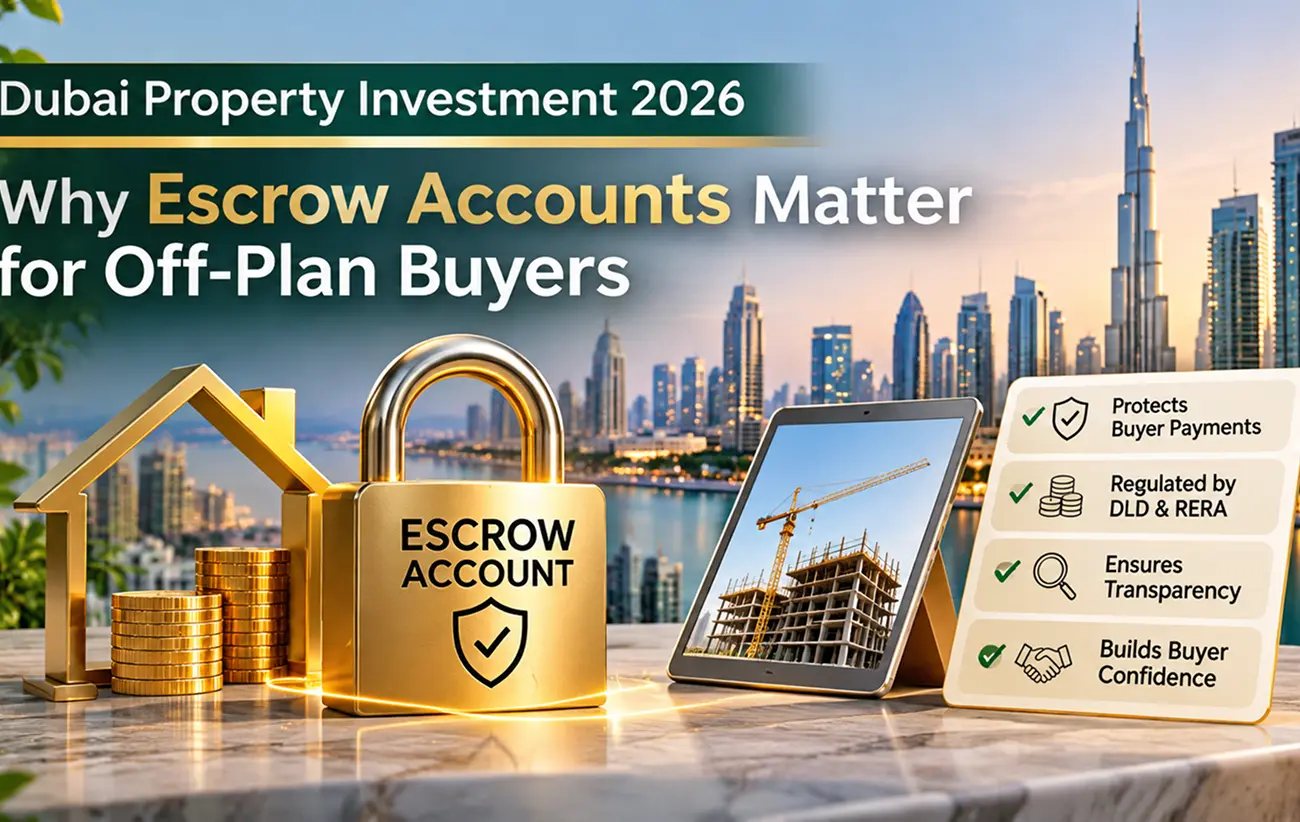
Dubai Law No. 8 of 2007 establishes a framework for escrow accounts used in qualifying off-plan real estate developments. Under this framework, buyer payments and eligible project financing are deposited into a project-specific account managed by an approved escrow agent. The system supports oversight and helps ensure that funds are used for the relevant development. It does not remove every property-investment risk or guarantee completion, a refund or a financial return.
| Buyer takeaway Before transferring money, independently verify the project, developer, escrow account and payment instructions through official channels. |
1. Dubai’s Property Market in 2026: Growth and Opportunity
Dubai’s real estate market entered 2026 after a year of significant transaction activity and investor participation. The following figures offer an overview of the market in 2025.
| Reported 2025 indicator | Figure in source draft |
| Total real estate transactions | AED 680B+; approximately 258,600 deals |
| Real estate investments | AED 917B+; over 270,000 transactions |
| Total property investors | 193,100; approximately 129,600 new investors |
| Off-plan residential sales | 148,391; stated as 72% of residential transactions (CBRE) |
Sources: Dubai Department of Finance and CBRE’s Q4 2025 UAE Real Estate Market Review.
Market activity can help buyers understand demand, but transaction volumes alone do not establish that a particular property is fairly priced or likely to appreciate.
2. What Is an Escrow Account in Dubai Real Estate?
A real estate escrow account is a bank account opened in the name of a specific development. Payments made by purchasers for off-plan units, as well as qualifying project-finance amounts, are deposited into the relevant project account.
Under Law No. 8 of 2007, developers selling units off-plan in covered real estate development projects must comply with the applicable registration and escrow requirements. The account is managed by an escrow agent approved by the Dubai Land Department (DLD).
The account is dedicated to the relevant development and is subject to controls on how funds are managed and disbursed. Buyers should still review the sale contract, developer track record, construction progress, location, pricing and payment obligations.
| Important An escrow account is a regulatory safeguard for project funds—not insurance against delays, cancellation, market losses or all contractual disputes. |

3. How Dubai’s Escrow Account System Works
- Developer and project approval: The developer and project must meet the relevant DLD registration and approval requirements.
- Project-specific account: The escrow account is opened in the name of the development and receives relevant off-plan purchaser payments and qualifying financing.
- Construction and payment checks: The escrow agent follows the account agreement and applicable requirements. DLD guidance describes site checks against construction milestones before eligible payments are released to service providers.
- Completion and post-completion retention: After the developer obtains the completion certificate, the law requires a 5% retention from the escrow account, subject to the statutory release timing described below.
This structure is intended to connect project funds with the development for which they were collected and provide regulatory oversight of account activity.
4. Key Benefits of Escrow Accounts for Buyers
- Project-specific fund management: Each project must have its own escrow account, dedicated to that development.
- Greater oversight: Escrow agents provide account information to DLD and are subject to regulatory oversight.
- Access to account records: The law allows depositors or their representatives to access their own accounting records and request copies.
- More confidence when buying remotely: International buyers can verify project and payment information rather than relying only on promotional material or informal assurances.
- A post-completion safeguard: Article 14 requires the escrow agent to retain 5% of the total value of the escrow account after the developer obtains the completion certificate. The retained amount is released to the developer one year from registration of the units in purchasers’ names.
The 5% retention is not a cash refund or compensation fund payable directly to buyers. DLD describes its purpose as helping ensure that defects apparent at completion or arising within the year after handover are addressed.
5. What Buyers Should Verify Before Making Payments
Use this checklist before paying a booking amount or any instalment:
- Developer registration: Check that the developer is licensed and registered with DLD.
- Project approval and status: Confirm that the project is registered and check its current status using DLD’s official project-status service.
- Escrow account: Verify that the account belongs to the specific project and is managed by an approved escrow agent.
- Payment instructions: Confirm the beneficiary name and account details independently with the developer through verified contact channels. Do not rely solely on forwarded messages or changed bank details sent by email.
- Sale and Purchase Agreement (SPA): Review the price, payment dates, construction milestones, completion provisions, cancellation terms, default consequences and buyer obligations. Seek independent legal advice if any clause is unclear.
- Construction progress: Compare developer updates with the latest information available through DLD.
- Oqood / interim registration: Ask how and when the off-plan sale will be registered and retain evidence of the registration.
- Receipts and records: Keep signed documents, bank confirmations, official receipts and all written correspondence.
DLD’s Real Estate Project Status service can be used to review available project information. Buyers should use official DLD channels and verify details directly rather than treating a brochure or sales presentation as confirmation.
6. Understanding Payment Plans and Financial Commitments
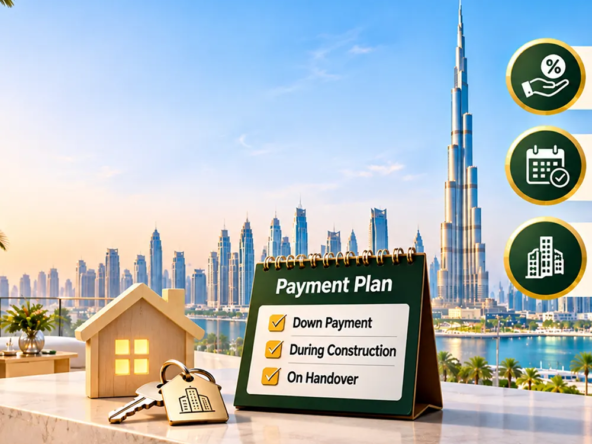
Off-plan developers may offer time-based instalments, construction-linked payments or post-handover arrangements. The exact structure varies by project and must be checked against the signed SPA.
For illustration, consider an apartment priced at AED 2,000,000 with a 60/40 payment plan:
| Payment stage | Percentage | Amount |
| Initial booking instalment | 10% | AED 200,000 |
| During construction | 50% | AED 1,000,000 |
| Upon handover | 40% | AED 800,000 |
| Total | 100% | AED 2,000,000 |
This example is illustrative and excludes DLD registration fees, agency charges, financing costs and other applicable expenses. It is not a representation of a particular developer’s current payment plan.
Before committing, check whether each instalment is linked to a date or a verified construction milestone, what happens if a payment is late, and which project escrow account must receive the payment. Build a budget that includes all purchase and ownership costs—not only the advertised instalments.
7. What Happens if an Off-Plan Project Is Delayed or Cancelled?
Construction delays can occur. Article 15 of Dubai Law No. 8 of 2007 addresses emergency situations in which a real estate development project is not completed. After consultation with DLD, the escrow agent must take the required measures to preserve depositors’ rights, including measures aimed at completing the project or refunding depositors’ payments.
The outcome depends on the project circumstances and the applicable regulatory and legal process. A refund should not be assumed to be immediate or automatic in every situation.
DLD’s published guidance distinguishes between projects under cancellation and projects that have been formally cancelled. It explains that, for a cancelled project, the account is transferred to the project liquidation department and the developer is requested to return investors’ payments within 60 days of the cancellation decision, subject to possible extension where RERA considers there are reasons to postpone. If the developer does not comply, the matter may be referred to court. Buyers should confirm the current status and applicable procedure directly with DLD.
If you are concerned about a project, keep your SPA, payment receipts and correspondence; check the official project status; contact the developer and DLD through verified channels; and obtain independent legal advice before taking steps to terminate or withhold contractual payments.
8. Is Escrow Protection Enough to Make a Good Investment?
No single safeguard can determine whether a property is a sound investment. Escrow regulation supports the handling of project funds, but buyers should also assess:
- Location, transport links and surrounding infrastructure
- Developer delivery history and the quality of completed projects
- Purchase price compared with similar completed and off-plan properties
- Expected rental demand, realistic rent assumptions and vacancy risk
- Service charges, maintenance costs and other ownership expenses
- Construction schedule, handover terms and potential delay exposure
- Resale restrictions, market liquidity and the likely costs of exiting
CBRE reported that Dubai’s off-plan residential transaction value reached approximately AED 395 billion in 2025, representing 31% annual growth. Strong market activity reflects buyer interest, but it does not guarantee future capital appreciation or rental performance.
A disciplined decision combines regulatory checks with realistic financial assumptions and a clear understanding of the buyer’s own objectives and risk tolerance.
9. How Le Nest Properties Helps Buyers Make Informed Decisions
A professional real estate advisor can help make the purchasing process more organised by helping buyers compare available developments, understand payment-plan structures, locate relevant project information and coordinate documentation with developers.
At Le Nest Properties, we aim to support clients throughout their Dubai property journey—from identifying opportunities aligned with their budget and preferences to understanding key purchasing steps. We encourage buyers to verify important project, registration and payment details through official channels and to seek independent legal or financial advice where appropriate.
| Considering an off-plan property in Dubai? Speak with Le Nest Properties to discuss your requirements and compare available opportunities. |
Conclusion: Build Confidence Through Verification
Dubai’s escrow account framework provides an important layer of oversight for off-plan property payments. Before investing, buyers should verify the developer, project registration, project-specific escrow details and payment instructions, and carefully review the SPA. They should also assess the property and its financial risks beyond the escrow arrangements.
With careful research, independent verification and appropriate professional guidance, buyers can make more informed decisions in Dubai’s property market.
| Disclaimer : Laws, procedures and project details may change. Buyers should verify current information with the Dubai Land Department and obtain independent professional advice before making a purchase. The information provided in this blog post is for general informational purposes only and does not constitute legal, financial, or investment advice. Le Nest Properties and its website do not assume any responsibility or liability for decisions made based on this content. If you are considering investing in Dubai real estate, we strongly recommend consulting with a qualified specialist or contacting us directly for personalized guidance. |